Notable People
Among the thousands of individuals in this family tree, a handful stand out for their remarkable lives, whether through achievement, public recognition, or the darker corners of history that nonetheless left a mark. Notable does not always mean admirable. All of them are worth telling.
John Nash was born in Bratton, Wiltshire, on 19 April 1763, the son of Thomas Nash. He grew up in the same village where he would eventually be buried, but the intervening decades took him to Bengal. He became a Branch Pilot in the Marine Establishment of the Honourable East India Company, the service responsible for guiding ocean-going ships up and down the Hooghly river between the Sandheads anchorage and Calcutta. The Hooghly was one of the most treacherous navigable rivers in the world, its channel perpetually shifting through quicksands and shoals capable of destroying a deep-draught East Indiaman without warning. A Branch Pilot needed to know it in all its moods, with lives and cargoes depending on that knowledge. Company records place Nash at Calcutta in 1795, 1797, 1801 and 1804, and still with the Marine Department in 1808 — a documented span of service across more than a decade, almost certainly representing a much longer career on either side. There is a record of a possible marriage in Bengal in April 1790 to a woman named Roza, though all attempts to trace the mother of his children have so far been unsuccessful. His four children — William, John, Eliza, and Annabella — were all born in Calcutta. Annabella died in 1827, aged around fifteen, predeceasing her father.
By 1835 Nash was back in Bratton, a pensioned Branch Pilot in his seventies. He made his will in December of that year, describing himself in its opening words as he would have wished to be remembered: a pensioned Branch Pilot in the Bengal Marine Establishment of the United Company of Merchants of England trading to the East Indies. He directed that he be buried at Edington, where his sister's remains lay — a wish that appears not to have been carried out. He died on 10 July 1836, aged seventy-three, and was buried four days later at St James' Church, Bratton. He left his estate of £4,000 in government stock — the accumulated fruit of his career with the Company, worth roughly £430,000 today — in trust to his friend Samuel Brint of Bratton. A quarter each went to his sons William, a sailor, and John, a tailor of Westbury. The remaining half went to his daughter Eliza, wife of David Snelgrove of Bratton, with careful provisions ensuring the money remained under her sole control regardless of her husband. His tombstone inscription, recorded by Jean Morrison before it weathered beyond reading, described him as a good master, a worthy friend, and a Samaritan to the poor and distressed, to the stranger and the sojourner. It ended in verse: The best of his days he spent abroad / Yet's anchored here by the will of God, / Torrid and frigid zone he passed / And safe at home arrived at last.
His daughter Eliza had been born in Calcutta on 9 January 1808, her father recorded at her baptism at Fort William in 1809 simply as John Nash of the Marine Department. She returned to England and married David Snelgrove of Bratton, a cordwainer, with whom she had ten children. She died on 16 July 1858, aged forty-nine, of a disease of the hip joint that had afflicted her for two years. No burial place has been found for her.
John Sadler was born at Huxley, near Chester, on 17 May 1806, and spent almost his entire life within a few miles of where he was born. He was a farmer, as his father and grandfather had been before him, working first at Brook Cottage and then, from 1838, at the old family homestead, Elm Tree Farm, Huxley. But it is not as a farmer that he is remembered.
In June 1819, when Sadler was thirteen, a Primitive Methodist missionary named Sampson Turner arrived in the village on a summer evening with a small group of companions, singing in the road. John's father stepped forward and offered his farmyard for them to preach in. Under the shade of several stately elms, Turner mounted a stool and spoke from Matthew 7:13. In the prayer meeting that followed, Sadler was converted. In his own words: "It was the turning point in my life. I had just attained my thirteenth year." He remained a member of the Primitive Methodist Connexion for the next fifty-two years, becoming a class leader and local preacher, eventually serving in those capacities for thirty-eight years without, as he recorded proudly in 1868, wilfully missing a single preaching appointment.
His life as a farmer was one of repeated trial. His first wife Elizabeth, his cousin, died in 1842 aged thirty-four, leaving three young children and the full work of a 120-acre farm on his hands. Within weeks an epidemic swept away all his cattle and then all his horses in a single week. He remarried Martha Findlow in 1845, and gradually recovered, only for further disease to strike his stock in 1859, and again in 1866, when the rinderpest killed twenty-eight head of cattle in five weeks. He valued the loss at between £400 and £500. "Surely this has been a wilderness world to me," he wrote. "I am indeed a wonder to myself."
He retired in ill health to Kelsall, where he died on 15 March 1871, aged sixty-four. His obituary in the Primitive Methodist Magazine the following year gave a lengthy account of his life, drawn partly from his own journals. He was buried at Huxley Jubilee Primitive Methodist Chapel, the very chapel that had been built on the site of his father's farmyard gate, where he had first heard the gospel preached from a stool under the elms. His son Ephraim, by then a prosperous glass merchant in Eccles, had been named among the founding trustees of that chapel when it was formally constituted in 1860.
George Cornish was born in Trudoxhill, Somerset in 1816, the son of a labourer. He spent his working life in Westbury, Wiltshire, moving through a succession of occupations: gardener, yeoman, innkeeper, farmer. He married Charlotte Taylor and raised a large family. His son William became a farmer and the father of George William Cornish, the Scotland Yard detective.
Westbury was a small and fiercely contested parliamentary constituency of around 1,125 voters, where elections had for years been decided by margins of twenty or thirty votes. George Cornish had long made himself useful at election time, serving as a paid canvasser. He had worked for the Liberal side at previous elections, including 1874. At the 1880 election he first offered his services again to Laverton, who declined. He then went straight to the Conservatives.
The Constitutional Association, formed to promote Phipps's candidature, held its meetings in public houses, with free beer distributed at each one. Counsel for the petitioner observed, not without irony, that the Association had with commendable prudence always assembled in a public house, as it might be difficult to interest a certain class of persons in politics in their dry aspect, but easy enough when associated with beer. The Cornish family were well placed to assist. George's son ran the Star Inn in Warminster and another son ran the Plough Inn on the Bratton Road. Voters were canvassed at the bar, offered drinks, and in at least one case a group of men were kept overnight in a house at Upton Scudamore, supplied with food, beer and tobacco over two days, and driven to the polls on the Wednesday morning.
The hearing opened on Monday 16 June 1880 at the Town Hall, Westbury, before Justices Lush and Manisty. It lasted four days and called twenty witnesses. What emerged was a system of bribery that was, as Justice Lush later put it, systematic rather than opportunistic. George Cornish carried a pocket-book in which he had recorded the initials of voters alongside Roman numerals indicating the amount each was to be paid. He showed it to at least one witness, telling him that twenty to thirty voters were listed, each to receive £5, with one down for £7. He was careful never to hand over money in advance. His rule was that no one would be paid until a month after the election, so as to avoid impeaching the seat. He would not pay his own father in advance, a witness reported him saying. He told the voters plainly: "If Mr. Phipps gets in you shall be paid." One witness asked him which side he was on. "I am as good a Liberal as you," Cornish replied, "but I am going to support a man who is going to pay me best."
His methods in the field were equally brazen. Meeting a labourer named Whitcombe on the road, Cornish kicked five small stones along the ground and asked "Will you do it for that?" The man understood him to mean £5. He refused. Cornish returned the following day and offered £1, £2 or £3, but still would not pay a penny in advance.
William Cornish was County Court bailiff and process server for the district, a man who collected rents for the Phipps family and, as counsel for the petitioner noted with some irony, had been employed to serve the subpoenas in the very petition that was now trying him. He acted alongside his brother throughout the canvass, offering voters money, the forgiveness of rent arrears, and in some cases new suits of clothes. One voter was served with a County Court summons on polling day itself, moments after casting his vote, by William Cornish, who told him it would not have happened if he had voted the right way.
On the Friday morning Justice Lush read the judgment. The bribery had been so numerous and so gross that both brothers must be reported to the Speaker of the House of Commons. He described George Cornish as a pest of the constituency who had sought to make money out of one side or the other, had been properly refused by Mr. Laverton, and had then switched allegiances without shame. No language was too strong to characterise a man who intruded himself into the ranks of a party to which he did not belong and went about among the humbler classes of voters trying to tempt them into crime. William had made common cause with his brother and was equally guilty. Nevertheless the judges found that neither man had been authorised by the Conservative candidate, and since agency could not be established the petition was dismissed. Phipps retained his seat. The costs fell on the petitioner.
Despite the judges' recommendation that the Attorney General consider prosecution, he declined in February 1881, telling the House of Commons that no money had been seen to change hands, only promises, and that a conviction could not be guaranteed. The Wiltshire Times was scathing, calling the existing corrupt practices laws miserably weak and the Cornishes pests who delighted in corrupting the humbler class of voters. The Corrupt Practices Act of 1883 followed, in part as a consequence of cases like this one.
George Cornish died on a Thursday morning in July 1898. He had gone to his field at the Butts, picked some broad beans, and was stooping to put them into the apron of a neighbour, Mrs Stiles the blacksmith's wife, when he called out "Oh, dear" and fell backwards. Before anyone could reach him he was gone. He was eighty-two.
Isaac Holmes was born in Hulme, Manchester in 1821, the son of David Holmes, a coal miner who had come to Manchester from the Glossop area, and Sarah Hough. They lived in Broom Square, Acton Street, one of the poorest quarters of Hulme. His mother died in 1844, aged forty-seven, and was buried in a public grave at Rusholme Road Cemetery. His father, by then a yarn dresser, died fifteen years later and was buried in a common grave at Weaste Cemetery. There was no money, no position, and no obvious path.
What Isaac Holmes built from those beginnings was remarkable. Starting as a warehouse man in 1841, he worked his way up through the Manchester cotton trade over the following decades, becoming first a salesman, then a yarn merchant, then a commission merchant, and eventually a full partner in Charles Leigh Clare & Co, cotton merchants of Manchester and Liverpool. He attended the Royal Exchange for almost fifty years. For a time in the 1860s the family lived at 2 Evelyn Terrace, Sloane Street, Moss Side, two houses from the family of Emmeline Pankhurst. By the time he retired, he had moved his family to Lyndale, Rawlinson Road in Hesketh Park, Southport, one of the most desirable addresses in the town.
He died there on 19 October 1896, aged seventy-five. The Manchester Guardian noted his death in its commercial markets column, recording that "regret has been expressed on 'Change" at the news, and that he had attended the Royal Exchange for almost fifty years. He left an estate of £35,948, equivalent to roughly £36 million today. He is buried at Sale Cemetery, Brooklands, where his grave carries one of the largest monuments in the cemetery.
Myles Crofton was a boatman working the Grand Canal Company's boats on the Limerick Canal, a working man on a working river. On Saturday 28 November 1891, Boat No 17 left Limerick for Killaloe with Crofton on board alongside two other crewmen and a fourth man who was not a boatman. When the boat reached Killaloe, Crofton was found unconscious, with seven wounds about his head and over both eyes. The police and a dispensary doctor were called, but he died the following morning in great agony. He was forty-five years old. He left a wife, Catherine, and eight children.
At the inquest, held on 30 November, the jury returned an open verdict. They could not say with certainty who had inflicted the wounds, but they put on record their concern for the welfare of Crofton's wife and family, and asked the Grand Canal Company to treat them mercifully. Three men who had been on the boat were charged and remanded to Limerick Jail.
One of them, George Farrell, turned Queen's Evidence. He told the magistrates he had heard a row in the cabin between a crewman named Frank Egan and Crofton, had seen them fighting with their fists, and had then watched Egan strike Crofton with his boot. The doctor confirmed the wounds were caused by violence, not accident. The Belfast News-Letter reported that one of the men had confessed to Crofton being repeatedly assaulted while the party were drinking on their way down the Shannon.
Egan was committed for trial. Farrell and a third man were released. What became of the trial, or of Egan, has not been established.
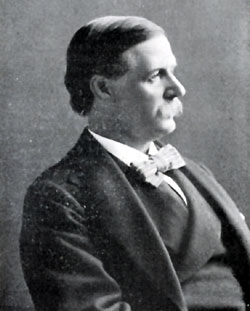
William Tattersall grew up in Brooksbottoms, a model mill village near Bury owned by John Robinson Kay, a place with no public house, a pioneering school, and a strong Wesleyan character. He was the youngest of ten children, and had been filing copy for the East Lancashire Echo since he was thirteen. He left school at fourteen to clerk in the mill office, earning six shillings a week, and from those modest beginnings built a remarkable career at the heart of the Lancashire cotton trade.
By the turn of the century he was commercial editor of the Manchester Examiner, Secretary to the Federation of Master Cotton Spinners' Associations, then the largest employers' organisation in the textile trade, and a regular contributor to The Economist and The Times. Governments on both sides of the Atlantic consulted him on cotton statistics. He was a Fellow of the Royal Statistical Society, a member of the Manchester Chamber of Commerce, and of the Cobden Club, the intellectual home of Victorian Free Trade. He appeared in Who Was Who 1897–1916 as a leading cotton trade expert and statistician, and was profiled in Lancashire Faces and Places in 1901. In January 1903 he resigned the secretaryship of the Federation, after ten years, to take up a newly created appointment from the Board of Trade as cotton trade expert correspondent for Great Britain and Ireland. In 1910 he was elected as a Liberal to Manchester City Council for Oxford Ward, serving on the Finance Committee where, as one colleague noted, his statistical knowledge made him exceptionally valuable.
His connection with Winston Churchill arose from their shared opposition to Chamberlain's tariff reform proposals. Between 1904 and 1908, as Churchill fought his way into the Liberal Party and won the seat for North-West Manchester, the two men corresponded regularly. Six of Churchill's letters to Tattersall survive, some marked Private, written on Colonial Office paper or from the Hotel Bristol in Paris, and were sold at Sotheby's in December 2002 for £11,352. Churchill wrote asking Tattersall to arm him with arguments against Chamberlain's Preston speech, to brief him for a Reform Club dinner, and to trust that he would not let his connection with Manchester drop. He never fully made good on that last promise.
Outside commerce and politics, Tattersall was a prominent figure in Wesleyan life. He was treasurer of the Manchester and Salford Federation of Free Church Councils, and the first treasurer of the Altrincham and District Free Church Council, of which he remained a member until his death. When the council passed a formal resolution of sympathy after his passing, they recalled that they were "indebted to him for many services direct and indirect."
Behind the public career lay years of private grief. In April 1875 he married Sarah Hannah Rigg, daughter of a draper from Littleborough, at the Wesleyan Methodist Chapel there. Their daughter Sarah Lilian was born in May 1876 but died aged three in February 1880, and was buried at the Wesleyan Cemetery on Thomas Street, Cheetham Hill. Sarah Hannah herself died in July 1890, aged thirty-seven, and was buried with her daughter in Grave 197FC. Seventeen years later her mother, Sarah Whitworth, was laid in the same grave. That cemetery closed in 1968 and in the years that followed fell into neglect and vandalism. In 2003 it was cleared for commercial redevelopment. The remains from Grave 197FC, along with those of over 20,000 others, were moved to a mass grave at Bury. The headstones were destroyed. The site is now a Tesco car park.
William remarried in October 1891. His second wife was Edith Potts, daughter of Edward Potts of Bury — ranked alongside P. S. Stott as the greatest mill architect of Victorian Lancashire, responsible for the design of some 200 mills. The losses continued: of the four children born to William and Edith, three did not survive infancy. Edith Mary lived seven days, Lucy one day, and Philip Crossley three months. Edward William, their second child, born November 1893, was the only one to survive.
William died at Melbrook on 22 October 1914. His funeral two days later drew a congregation that reflected the full breadth of his life. The service was held at Hale Road Wesleyan Chapel before burial at Hale Cemetery, preceded by the Hale troop of Boy Scouts with reversed flags. Among those present were the Lord Mayor of Manchester, the Town Clerk, the City Treasurer, and delegations from the Manchester Liberal Federation, the Manchester and Salford Free Church Federation, and the various Liberal agencies across the city. The minister noted that tributes had come from the commercial world, the civic world, and the church alike, and that in every one the testimony was the same: his warm-heartedness, his generosity, his faithfulness and his kindness. On the evening before his death he had dined with the Manchester Watch Committee, returned home to Melbrook in good spirits shortly before eleven, and went to bed. At two in the morning he knocked on his wife's door: "I am poorly." By the time the doctor arrived he had died of heart failure. He had been writing his weekly column on trade and finance the Saturday before.
Edith outlived him by twenty-three years and was a formidable figure in her own right. By 1908 she had served six years as a Poor Law Guardian, formed the Liberal Women's Suffrage League and become its first President, written serial stories for the weekly press, and corresponded with prime ministers. After William's death she and Edward left Cheshire for Brodick on the Isle of Arran — a place the family had holidayed since the 1880s — where she built and ran the Glenartley Hotel on Mayish Road and became a prominent figure on the island. She died in Wembley in May 1937, described in the Ardrossan and Saltcoats Herald as 'late of Brodick, Arran.'
Edward built a distinguished career of his own. Rejected by the forces on health grounds in 1914, he turned to photography — first on Arran alongside his mother, where he founded a successful photographic business, served as local correspondent for several newspapers, contributed to musical organisations, and was described on his departure as the devoted “chief consoler and companion of his suffering parent,” meriting, as the Brodick press recorded, “the warmest esteem from the Brodick public.” From Arran he moved progressively across Fleet Street, contributing regularly to The Times, the Daily Telegraph, and the Methodist Recorder, where a colleague recalled he was 'in all but name a staff photographer' for thirty years. His work appeared in national newspapers, magazines, calendars, postcards, Christmas cards, travel books, and even the Encyclopædia Britannica. He covered the Methodist Conference for over thirty years, beginning at Birmingham in 1943 — though for seven years before photography was permitted at ministerial sessions he beat the ban by secreting himself behind a curtain. When the ban was lifted, he marked the occasion by letting off a flashbulb a few feet from a speaker in full rhetorical flow; the conference cheered. After that, whenever a speaker went on too long, delegates would call out: “Shoot him, shoot him!” His first sale — to both the Methodist Recorder and the Methodist Times — had been a mistimed flash shot of Samuel E. Keeble praying at a Methodist Peace Meeting at Kingsway Hall in the 1930s, the flash having stubbornly refused to function during the speeches. In 1977, at the age of eighty-three, he was awarded the Queen's Silver Jubilee Medal. In 1942 he had met a Swiss nurse, Marta Flubacher, on a walking holiday in Keswick; they married and settled in St Albans, where Marta became his assistant. He worked until he was ninety-one, died in May 1987 aged ninety-three, and his ashes were scattered in the area known as Bluebell Wood at the West Hertfordshire Crematorium. His widow later sold his archive of hundreds of photographs and slides to the Methodist Recorder. He left no children.
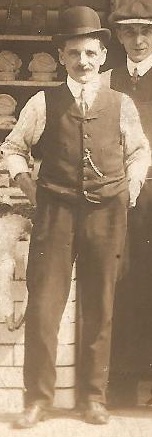
Joseph Brickland was born in 1852 in Chester, the son of Joseph Brickland senior, a shoemaker from Northampton who had moved to Chester and reinvented himself as a fishmonger, establishing a shop at 11 Northgate Street. The younger Joseph built the business into something considerably more substantial, moving to Bridge Street and running it for over half a century. The Brickland name became well-known in Chester, the shop serving the city's gentry with fresh fish and provisions.
But it is not only as a fishmonger that Joseph is remembered. A 1966 article in Deeside, drawing on the recollections of a neighbour, recalls him as a pioneer in all forms of transport and as a dapper little man, sharp as a needle, bright as a new sixpence. The winter of 1895–96 was very severe and the Dee was frozen for many weeks. During this time he was to be seen every morning with his pony and trap, taking his sons Bill and Joe for a drive to Eccleston and back. He is believed to have been the first person in Chester to ride a motorcycle, and the same neighbour recalled that the first motor car he ever saw in the city was driven by Joseph Brickland.
He died in October 1927, aged seventy-five. His wife Sarah had predeceased him in 1919. He left the business to his sons William and Joseph.
Dorcas Harriet Giles was the twelfth child of Henry Giles, a glove cutter of Reckleford Street, Yeovil, and his wife Harriett. She was seven years old in the spring of 1863. There is nothing more in the record about her life: she was at school in 1861, and two years later she was dead.
On Wednesday 13 May 1863, Dorcas ran into the road in Reckleford Street in front of a horse and cart coming down the hill at a jog-trot. The cart was loaded with six hundredweight of manure and was being led by Charles Walbridge, a twelve-year-old boy in the employ of a Mr Hawkins of Preston. He tried to push her aside, but she ran forward, and the wheel passed over her head. She died on the spot.
The inquest was held three days later at the Glover's Arms, the public house on the same street, whose name reflected the trade of her father. The witnesses told what they had seen. The jury returned a verdict of accidental death, noting that Walbridge had not been driving furiously. But one juror spoke up. There was, he said, a great deal of furious driving in the streets of Yeovil, and it would be well for the police to attend to it. With no playground but the public roads, it was surprising there were not many more accidents.
Robert Kitching was a market gardener at Leeming in the North Riding of Yorkshire, a small village two miles from Bedale. He had a wife, four young children, a hook where his left arm had been, lost in a gun accident years before, and a reputation throughout the village for a violent and ungovernable temper. He had been before the magistrates on more than one occasion. His grievance against the local police sergeant, James Weedy, had a specific origin: Weedy and the local excise officer had both reported him for driving his conveyance without a licence. As late as 31 August 1890, just three weeks before the murder, Kitching told the excise officer that Weedy wanted shooting.
James Weedy was forty-three years old, a native of Hoppen near Bamburgh in Northumberland, and had come to policing from the Cleveland Miners' Association. He was a powerful man, 5ft 10in, described as having a nerve of iron, and was known for his devotion to duty. Some months before his death he had been offered a transfer to Richmond, a step up in rank. He petitioned against it, citing the difficulty the move would present for his large family, and considered himself fortunate to remain at Leeming. He had no idea what was waiting for him.
On the evening of 19 September 1890 events came to a head. Weedy found Kitching drunk and causing a disturbance outside the Leeming Bar Hotel and told him to take his pony and cart and go home. In front of witnesses, Kitching stated plainly what he would do before the night was over. At some point that evening Mrs Kitching, in great distress, fled with her baby and then returned for the other three children, bringing them in their nightgowns to a neighbour three doors away. Weedy, knowing the man, followed him home. He did not make it back. Kitching went into his house, returned with a loaded gun, and shot him dead at point-blank range.
Weedy's funeral, held on the Tuesday afternoon following the murder, drew around 1,200 people. The Londonderry estate and a local iron foundry gave their workers the afternoon off to attend. The North Riding Constabulary turned out from the Chief Constable downwards. The Bedale Rifle Band played the Dead March in Saul. Six fellow constables bore the coffin. The church was packed to the doors, the coffin covered in wreaths. A public subscription was opened for the widow and twelve children. It was the community's verdict on the man Kitching had killed.
The investigation was brief; the evidence overwhelming. What the inquest and subsequent trial revealed was not a crime of sudden passion but something more disturbing: a man who had announced his intention, carried it out, and then carried on. After the killing Kitching walked to his father-in-law's house to report what he had done, moved the body, threw the gun into a nearby beck, and then went to bed. He rose at five the following morning, loaded his cart with a pig and some fruit, and drove to Richmond market. He was arrested at his stall.
In December 1890 the Crown Court at York Castle was besieged from early morning, many turned away at the doors. Defence counsel was S. D. Waddy Q.C. M.P., who argued that Kitching, one-armed, had been parrying Weedy's blows with the gun when it accidentally discharged. The judge's summing up focused on a question the defence never answered: why did Kitching have a loaded gun at his gate at all? During Waddy's speech Kitching broke down and wept. After the guilty verdict he made a long, rambling statement: admitting he had done very wrong to take the gun out, accusing his father-in-law of lying, blaming the gun's defective mechanism, blaming drink, and ending in tears. The judge listened with his face in his hands; when he looked up to pass sentence, his eyes were visibly wet. He was hanged at York Castle on 30 December 1890. The execution was private; press were not admitted. The executioner was Billington. Outside, a crowd gathered to watch the black flag raised from Clifford's Tower. Kitching had passed a troubled night; the chaplain came at six. Standing over the drop he seemed to reel and nearly fainted, but the bolt was drawn immediately. Before the end he left a confession of guilt with the chaplain, though its contents were never made public.
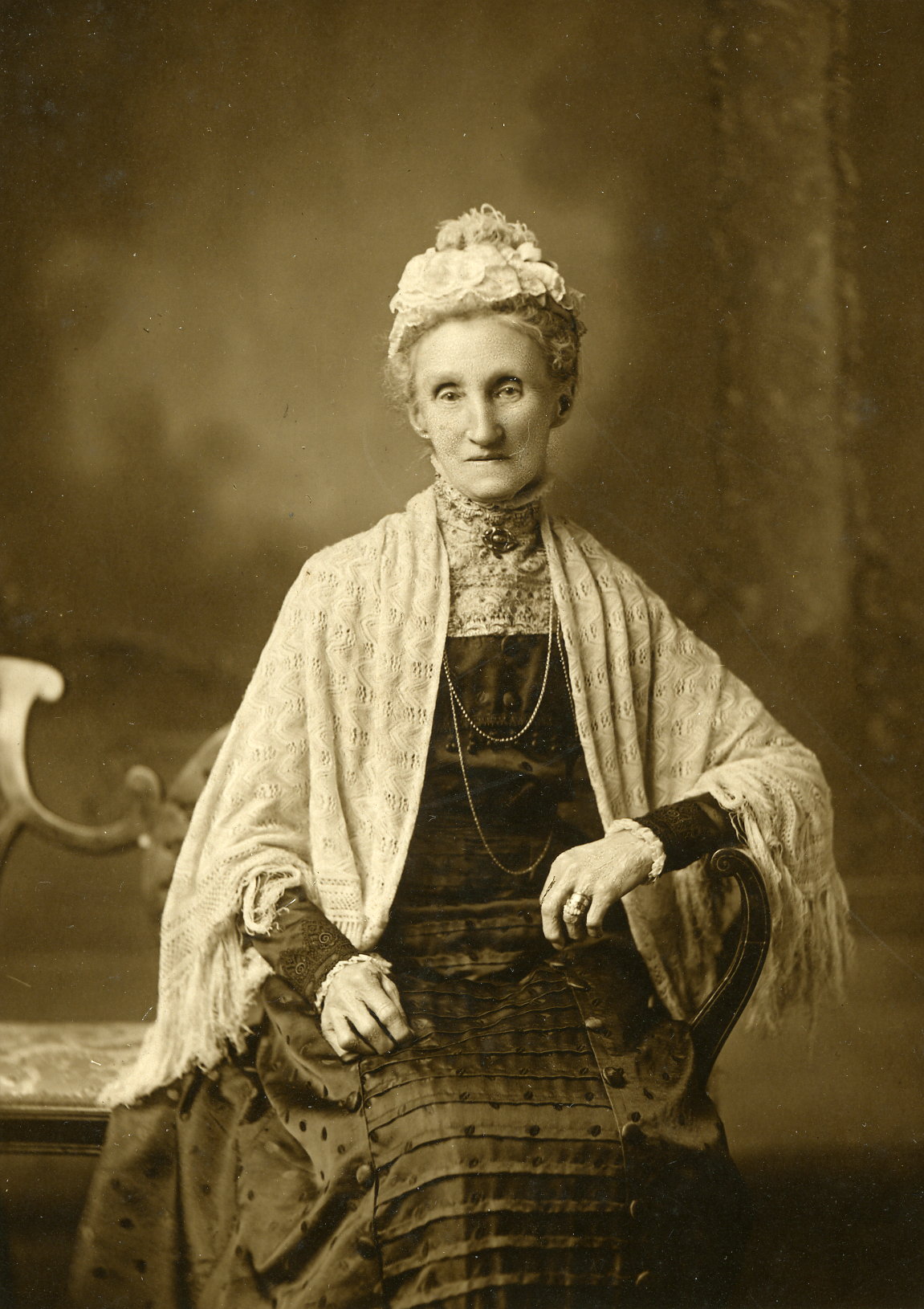
Elizabeth Holmes was born on 1 September 1861 in Hulme, Manchester, the daughter of Isaac Holmes, cotton merchant, and Sarah Vickers. She grew up in comfortable circumstances and in 1881 the family was living in Stretford with two servants. In 1883 she married John Herbert Stones, a paper merchant, and the couple settled in Sale, Cheshire, where their two sons Eric and Shepherd were born in 1891 and 1892. John Stones died in July 1893, aged thirty, leaving Elizabeth a widow with two boys under two years old.
She remarried Joseph Edwin Taylor in 1896, and the family moved to Ravenswood, Homer Road, Solihull, where both sons grew up. Shepherd, known to the family as Shep, was educated at Mintholme College, Southport, and Rydal Mount School, Colwyn Bay, before joining Lloyds Bank in Birmingham as a clerk in 1910. When war came, both sons enlisted. Shepherd was commissioned Second Lieutenant in the 5th Battalion Northumberland Fusiliers. On 3 November 1916, aged twenty-four, he was shot in the head by a sniper at Cough Drop Trench, Flers, and killed. He is buried at Bazentin-le-Petit Communal Cemetery Extension. Eric, who had volunteered early and served as a Pioneer with the 3rd Special Company Royal Engineers, made his will in August 1916, leaving everything to his mother. He was killed at Armentieres on 9 April 1918, aged twenty-seven. He has no known grave and is commemorated on the Pozieres Memorial.
Both sons are commemorated on the Solihull war memorial. Elizabeth also paid for the restoration of the altar in St Anthony's Chapel at St Alphege Church, Solihull, in remembrance of Eric and Shepherd, and applied for Shepherd's service medals in 1922. By around 1920 she had moved to Chelston, Brompton Avenue, Rhos-on-Sea in North Wales, where she lived until her death.
She made her will on 17 October 1930, three months before she died. It is a careful, considered document and a revealing one. She left five diamond rings to five different nieces, a pearl and diamond ring to a sixth, and a catseye ring to her friend Helen Ward as a slight acknowledgment of her never failing kindness. She provided a lifetime annuity to her companion Elsie Lilian Whitehill, conditional on Elsie remaining unmarried. She left £100 each to St Dunstan's, for blinded soldiers and sailors, and to the Lord Roberts Memorial Workshops Fund, charities for disabled veterans almost certainly chosen in memory of her sons. She sincerely hoped, she wrote, that none of her nieces and nephews would marry anyone other than a British subject. And she noted with evident regret that excessive taxation and capital depreciation in recent years had forced her to reduce several bequests from what she had intended in earlier wills, adding that those omitted were in any case better provided for than those she had included.
One of the rings, a five-stone diamond ring in platinum left to her niece Doris Macbeth, passed in turn into Doris's own will, where it was left to Gillian Tattersall. The solicitor appointed executor of Doris's estate was struck off in 2012 and made bankrupt, and the bequest was never received. The ring was lost within the family.
Elizabeth died on 3 January 1931, aged sixty-nine, of cerebral degeneration. She was buried at Sale Cemetery alongside her first husband. Her grave carries the names of all three: John Stones, and the two sons she outlived. She left an estate of £26,652.
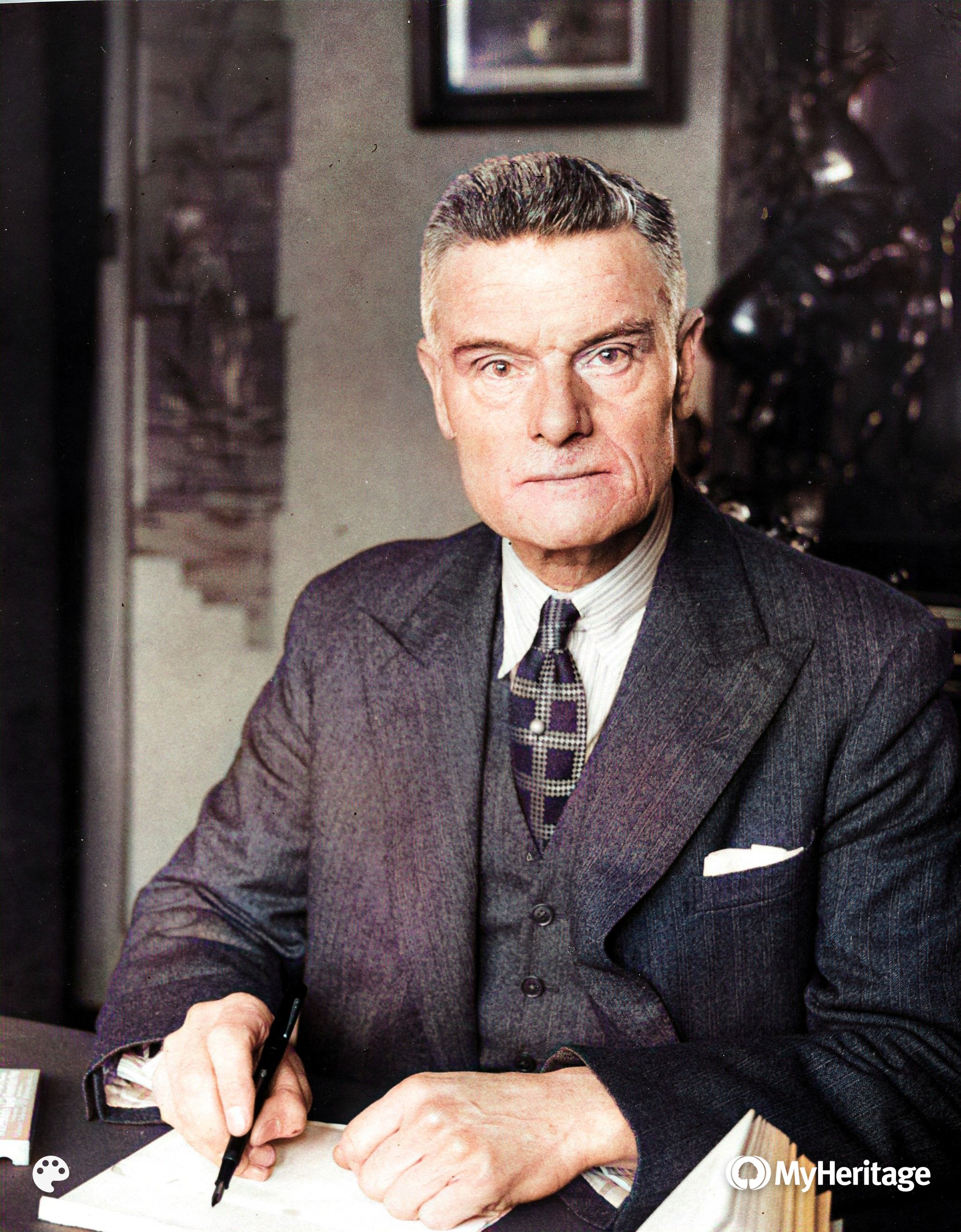
George Cornish was born on a farm in Westbury, Wiltshire, and might easily have spent his life there. He was working the land at Birchanger Farm in 1891 when a conversation with a detective visiting his father changed the course of his life. In March 1895, aged twenty-one, he presented himself at Whitechapel police station, in his own later words at a time when it was unsafe to walk the streets of the East End at night, and joined the Metropolitan Police.
What followed was nearly four decades of methodical ascent through Scotland Yard: constable to CID sergeant at Whitechapel, detective inspector at Kentish Town, and finally Detective Superintendent at C1 Department, the Yard's most senior criminal investigation branch. He became one of the original "Big Five", the small group of senior CID officers whose names were synonymous with Scotland Yard in its heyday. He retired on 31 October 1933 after thirty-eight years of service.
His cases spanned four decades and several of the most notorious crimes of the era. He traced the chemist's shop where Dr Crippen obtained the poison used to murder his wife. He arrested Henry Jacoby, the pantry boy who killed Lady White in a Marylebone hotel. He led the investigation into the murder of ten-year-old Vera Page at Notting Hill in 1931. He once took the fingerprints of a king: when King Manoel of Portugal had jewels worth £30,000 stolen from his Twickenham mansion, Cornish took the prints of everyone in the house, including the king and his consort.
His most celebrated case came in May 1927. A large black trunk deposited at Charing Cross left-luggage began to smell after five days. Inside was a woman's dismembered body, each limb wrapped in brown paper. The office at 86 Rochester Row where the killing had taken place was traced, but found scrupulously clean, as if the murderer had already won. It was Cornish who found a bloodstained duster in the trunk. Washed and re-washed, it yielded a single word: Greyhound. He and his men visited 120 Greyhound hotels in London before finding that an ex-employee named Robinson had an office in Rochester Row, the very office from which a taxi had taken the trunk to Charing Cross. Cornish later said simply: "It was a duster that really hanged Robinson." Robinson was tried at the Old Bailey, convicted on the evidence of Sir Bernard Spilsbury, and hanged at Pentonville that August. In 1935 Cornish published his memoirs, Cornish of the Yard.
His last years were difficult. His daughter Margaret died in 1939 at just thirty-two. In December 1958, at the age of eighty-five, he was admitted to Friern Hospital in Barnet, admitted, the record states, with one penknife and three keys. He died there in February 1959 and was cremated at Enfield.
Wilfrid Norman Sadler was born in Eccles in 1897 into a prosperous and outwardly respectable Lancashire family. His father, Wilfrid Ernest, ran a successful plumber's merchant business from Ardwick Green in Manchester. The Sadlers lived in the large house at Danesbury on Chatsworth Road and, by any measure of the time, had done well.
But the family was no stranger to tragedy. Wilfrid's younger brother Ewart, a private in the Manchester Regiment just eighteen years old, cut his own throat with a razor on New Year's Day 1917, whilst billeted in a house in Southport. He was buried at Monton Unitarian Church, where the family had long worshipped.
By the early 1920s Wilfrid's own life had begun to come apart. His first marriage, to Dorothy Longbottom, had broken down, leaving behind two daughters, Dorothy and Bette, then toddlers. His motor mechanics business at Duke Street, Southport had failed. His father took him on casually at the Ardwick warehouse to give him something to occupy his mind, but colleagues noticed he seemed a different man, moody, depressed, and convinced he could do nothing right. He came home to live with his father at Danesbury House. His aunt, Elizabeth Martha Sadler, lived alone nearby at 39 Chadwick Road, and the two had always been devoted to each other.
On the afternoon of 10 January 1924 he left the warehouse early, telling his brother Eric he felt unwell. At 6.15 that evening he approached two constables in Liverpool Road and said: "I have murdered my aunt. It was her or me. I was up against everything. I did it to get hanged." The officers broke into the locked house at 39 Chadwick Road and found Elizabeth Martha Sadler on the kitchen floor, dead, a razor beside her. The following morning, in his cell, Wilfrid made a further statement: "I carried the razor in my pocket for a week with the intention of cutting my own throat. I could not pluck up the courage to do it. I thought I could not make a proper job of it. I then thought I would do it on someone else and this is what I have done." He was taken to Strangeways four days later, committed for wilful murder, and brought before Manchester Assizes on 22 February, where three medical men agreed he was insane and unfit to be tried. The examining doctor testified that Wilfrid believed he had killed no one, that some power inside him had killed someone in his presence, and that since the crime he had been hearing his aunt's voice. He was ordered to be detained during the King's pleasure.
His father did not abandon him. By 1939 Wilfrid was living quietly at Hawarden, 59 West Drive, Thornton Cleveleys, working again as a motor and electrical engineer. After the war he married Mary Johnson, who had worked as a shop assistant in his father's plumbers' merchant business in Cleveleys. When Wilfrid Ernest died in 1944 he left his son property on Rossall Road and a share of building land at Cleveleys. It was a practical act of faith in a man whom the world might easily have written off. Wilfrid made his will in 1951 and died at 17 Park Road, Cleveleys, in October 1959. He left effects of £2,982. He outlived all three of his brothers, Ewart (1917), Eric (1953), and Harry (1958). He was sixty-two.